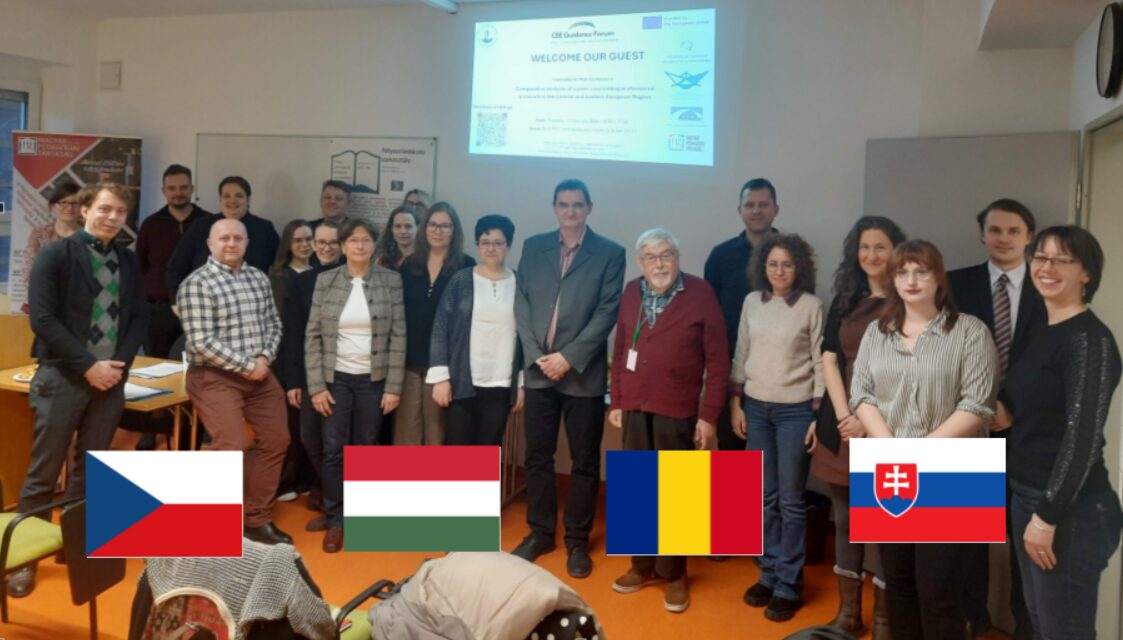
A webinar held on 08/04/2026 brought together career guidance associations from Slovakia, the Czech Republic, Hungary and Romania. The focus was on what role do these associations actually play, and what are they dealing with on the ground? The discussion was based on a small research project looking at how these organisations function, what they offer to members, and how they connect to wider guidance systems.
What the associations do
Across the four countries, the core activities are similar. They organise training – webinars, seminars, workshops. They create spaces for practitioners to meet and exchange. They collect and share tools. In some cases, they contribute to national discussions on guidance policy. In Hungary, this includes joint conferences with universities and public institutions, regular webinars with partners, and maintaining a shared repository of resources, as showcased by Szalai Máté. In the Czech Republic, the association runs on a small volunteer base. Activities include annual meetings, seminars, Erasmus+ projects, and participation in national and international networks. One recurring format is a full-day seminar open to counsellors from different sectors, focused on practical methods and tools, as presented by Zuzana Freibergová and Alice Mullerová. In Slovakia, formats are sometimes more informal: small events like “coffee with a counsellor” or broader initiatives such as a careers week aimed at increasing visibility.
Members join associations for contact with others doing the same work. The value is in exchanges with peers, access to practices, and the possibility to step out of professional isolation. This is especially relevant in systems where career guidance is spread across multiple sectors and not always clearly structured as a profession.
The successes and difficulties
All associations described the same limits: Small membership bases, a handful of active people doing most of the work, no stable funding, no paid staff, or very limited. This has direct consequences: fewer activities than planned, difficulty maintaining communication with members, and limited capacity to engage in policy work. The discussion pointed to a shared set of problems:
- unclear or weak professional standards
- uneven access to guidance services
- difficulty building active professional communities
- low visibility of career guidance in public policy
These are not new topics. What is clear is that associations are trying to address them, but with limited leverage.
If you look at how career guidance functions in these countries, these associations are doing part of the system’s work—often without being recognised as such. They support professional development where formal structures are missing or insufficient. They connect practitioners across institutions. They keep some level of coherence in a fragmented field.
Despite these difficulties, the associations manage to organize an impressive set of activities and good practices, as showcased in the recently published repository of good practices.
Find the presentation of the event here: https://cloud.rozvojkariery.sk/s/BPKW3borrnmrd6E