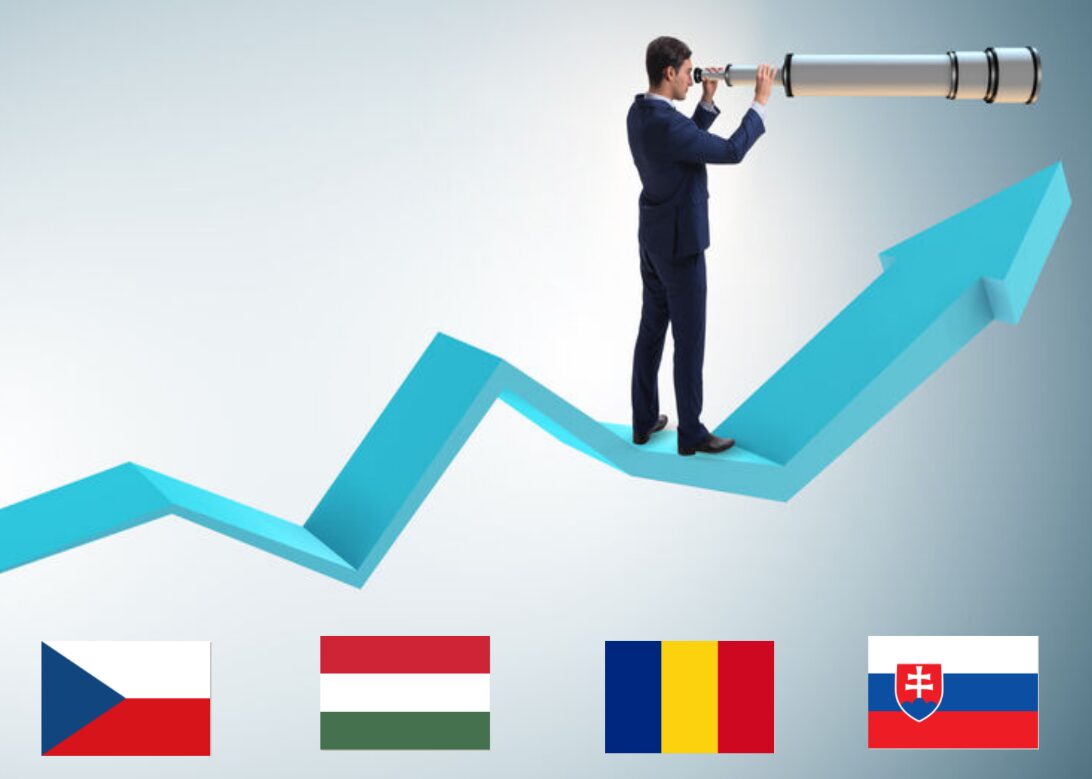
On 29 June 2026, the Central and Eastern European Guidance Associations’ Forum (CEEGAF) held the closing webinar of its first cycle of activities, bringing together career guidance practitioners, researchers, and ministry representatives from Czechia, Hungary, Romania, and Slovakia. Just days earlier, on the preceding Monday, the four founding associations had formalised their cooperation in Bratislava by signing a Memorandum of Cooperation.
The forum’s work, developed with Erasmus+ co-funding, has already produced three concrete outputs: a set of guidelines based on comparative benchmarking of the four associations, a repository of more than 25 documented good practices, and a position paper calling on national governments and the EU to recognise guidance associations as legitimate partners in policy-making and to support the sustainability of professional associations and regional cooperation.
Hungary: strong practice, thin system architecture
Presenting research from CEEGAF’s comparative work which used Finland as a benchmark, the Hungarian contributors described a system that is, in their words, “deep but narrow”: strong in individual practice but light on system-level integration. Hungarian guidance professionals are well trained in assessment and structured counselling, reflecting the country’s psychological tradition, but there is no unified national competence framework, and areas such as ethics, service evaluation, and digital competence remain only loosely defined.
The proposed way forward is a five-step sequence: build a national competence framework through collaboration among practitioners, trainers, and policymakers; strengthen system-level competences such as evaluation, quality assurance, and cross-sector coordination; expand training and continuing professional development to include ethics, supervision, and research literacy; build digital and innovation capacity, including attention to data protection in online counselling; and invest in the wider professional ecosystem, including cross-sector cooperation between education, employment, and social services. The presenters framed this as a shift from a fragmented, practice-driven system toward an integrated one, drawing on both domestic tradition and comparative lessons from the region and from Finland.
Romania: standards up for renewal, a new window for schools
Dr. Vasile Deac, representing Romania’s Association for Career Guidance and Career Development, brought what he called good news for the sector. Under Romanian legislation, professional training standards are periodically reviewed, and the standards underpinning the “Career Orientation Counselor” and “Professional Development Counselor” qualifications are currently due for renewal — an opening he described as a genuine opportunity for the professional association to help shape their replacement.
In parallel, the Ministry of Education’s ConsEDU project is developing a package of tools for schools: a general framework for career counselling built on a whole-school approach, a career counsellor profile, an ethical guide, quality standards, a partnership protocol, and a practical toolkit. Association members are involved as experts on the university and ministry teams delivering the project, and Deac expects the resulting standards to feed back into the labour-market-facing qualifications as well.
He also flagged a longer-term structural question: career counselling in Romania currently has no dedicated professional body of its own and sits, somewhat uneasily, under the authority of the Psychologists’ College. An ongoing debate about whether therapists should form their own separate college was described as a potential opening for career counsellors to make the case for a professional body of their own – a “MODEL” already partly worked out under the ConsEDU project.
Czechia: two ministries, two concrete levers
Petr Chaluš of the National Pedagogical Institute presented developments from both the labour and education sides. On the labour side, the DIGIcourses project (2026–2028), funded through Operational Programme Employment+, is primarily aimed at building digital skills among registered job seekers, but it also creates a mechanism for individual career counselling delivered by external, professionally qualified providers, funded through the existing Database of Re/Upskilling Courses. The Czech Labour Office will cover 77% of the cost, with clients contributing the remaining 23%, up to a maximum contribution toward counselling of roughly €280. Unlike existing labour-office services, this channel is intended to be open to the general public, not only registered unemployed people.
On the education side, a new legal provision now places responsibility for coordinating career guidance and counselling explicitly with school leadership, framed as a whole-school responsibility rather than the task of a single specialist. A new working group under the Ministry of Education, of which Chaluš is a member and which will be supported by the National Guidance Forum from later in the summer, is now developing practical guidance for schools on how to meet this obligation and on strengthening the professional preparation of school guidance counsellors.
Slovakia: a new qualification recognition, built on the association’s own standard
Presenting the most structurally novel development, Tomas Sprlak outlined Slovakia’s new national validation and certification system for career guidance counsellors working with adults, introduced under Act No. 292/2024 on Adult Education and opened for applications in May 2026. Until now, guidance for adults outside the employment and education sectors was not a regulated profession, and there was no statutory quality assurance – even though the professional association had operated its own informal quality standard since 2018.
The new qualification is pegged at EQF Level 6, issued without time limit, and comes with a Europass supplement. Practitioners can still work without it, but the certificate is required to draw on public funding — notably the new Individual Learning Accounts (IVÚ), a personal learning budget of €200 per citizen in the pilot phase that can be spent on career guidance services alongside digital and green skills training.
Candidates can reach the certificate by two equally valid routes: completing accredited formal training, or having a three-member commission assess a portfolio built around a documented real client case study, which can lead to full recognition without any exam. As of the webinar, 11 applications had been received and three certificates issued, all three through the portfolio route rather than an exam – a detail the presenters read as a signal of trust in experienced practitioners. Notably, the underlying qualification standard was substantially built on the quality framework the Slovak association itself developed in 2018, making this, as Sprlak put it, a largely practitioner-driven design.
The eight competence domains candidates must demonstrate span theoretical foundations, counselling process and skills, ethics and work with target groups, self-knowledge methods, career planning methods, labour-market information and digital trends, multidisciplinary collaboration, and quality and effectiveness – with a pass threshold of 75% per domain where an exam is required. Candidates must also demonstrate the ability to deliver group counselling, a deliberate inclusion the presenters noted is often underdeveloped among adult-guidance practitioners used to one-to-one work.
The issue of sectoral fragmentation
The closing discussion returned to a theme that ran under all four presentations. Dr. Borbély-Pecze Tibor Bors observed that the earlier CEEGAF benchmarking against the Finnish standard had highlighted Finland’s intersectoral design – one framework applicable across schools, public employment services, and both municipal and state level. By contrast, he noted that each of the four countries currently advances guidance largely sector by sector: strongly through the school system in Czechia, through adult education and individual learning accounts in Slovakia, and through separate projects in Romania. He posed it as an open question — how far project-based, sector-specific progress can go while system-level, cross-ministry integration lags behind.
Responding for Slovakia, Sprlak noted that despite an existing National Guidance Forum bringing together the ministries of labour and education, that cooperation has rarely translated into deeper joint policy work, with initiative shifting between ministries depending on the political cycle. Chaluš described a similar pattern in Czechia, with labour-market and school-based guidance still operating as largely separate systems, though communication between the sectors is reasonably good – leaving better cross-sector coordination as a plausible next step for the region.