
A visual wheel activity where participants rate eight well-being dimensions, revealing personal balance and sparking reflection on interconnections between emotional, physical, social, and career areas.
Target group:
Career counsellors and their clients. The activity can be used both in training sessions for counsellors and in individual or group work with clients.
Duration:
- Approximately 60 minutes in group form
- Approximately 40 minutes in individual form
Inspiration for the tool:
Developed by Slovak practitioners and trainers in career guidance as part of a well-being module. The activity draws inspiration from positive psychology and well-being theories. It combines theoretical understanding with reflective practice and experiential learning.
Well-being is a multidimensional concept that reflects a person’s overall sense of balance, fulfilment, and vitality in life. It goes beyond the absence of illness to include emotional, physical, social, intellectual, environmental, financial, professional, and spiritual dimensions. According to the Oxford Dictionary, wellness means “the state of being in good health, especially as an actively pursued goal” .
Well-being is closely linked with identity and values. Our sense of who we are and what we find meaningful shapes the way we define and pursue well-being. Theoretical frameworks such as Seligman’s PERMA model (Positive emotions, Engagement, Relationships, Meaning, Achievement) or the OECD Well-being Framework highlight that well-being results from the interaction of personal, social, and environmental factors. It is not a fixed state but a dynamic process of aligning one’s actions, environment, and values to sustain a healthy and satisfying life.
The PERMA model, developed by Martin Seligman within positive psychology, proposes five core elements of well-being: Positive Emotion, Engagement, Relationships, Meaning, and Accomplishment – that together help explain how people experience sustained well-being across life domains. Each dimension contributes to well-being not only as an isolated factor but also through their dynamic interplay, supporting resilience and life satisfaction.
P – Positive Emotions : Experiencing pleasant emotions such as joy, gratitude, relief, hope, or calm. These emotions broaden perspective, support motivation, and buffer stress.
Examples: A client feels relief and pride after clarifying their options during a guidance session. A counsellor notices satisfaction after a meaningful conversation rather than focusing only on outcomes. Celebrating small wins: completing a CV, making a difficult phone call…
E – Engagement: Being deeply involved in an activity, often described as “flow” — using one’s strengths, skills, and attention fully.
Examples: A client becomes fully absorbed while talking about a project they loved in a previous job. A practitioner experiences engagement when facilitating a group workshop. Noticing moments at work when time passes quickly because the task feels meaningful and aligned.
R – Relationships: Having supportive, trusting, and meaningful connections with others — a key protective factor for well-being.
Examples: A client feels supported by a counsellor who listens without judgement. Peer exchanges between practitioners that reduce isolation and foster professional learning.
M – Meaning: Feeling that one’s actions are connected to something larger than oneself — values, contribution, purpose, or social usefulness.
Examples: Reflecting on how one’s work contributes to others, a community, or society. A practitioner finds meaning in supporting vulnerable clients or promoting more sustainable career choices.
A – Accomplishment: The sense of achievement that comes from setting goals, making progress, and recognising effort – not only success.
Examples: Completing a training, updating professional skills, or gaining confidence. A counsellor recognising the value of consistent, “invisible” work with clients over time.
Ecological well-being frameworks expand this view by highlighting that human well-being is deeply embedded in and shaped by our relationships with natural and social environments – including access to healthy ecosystems, meaningful connections with nature, and the long-term sustainability of the systems that support life. These approaches stress that well-being cannot be fully understood without acknowledging how environmental conditions influence physical health, psychological states, social cohesion, and opportunities for meaningful engagement.
In the context of career guidance, reflecting on well-being helps individuals reconnect with their identity and values, recognise what truly supports their well-being, and make choices that are both personally fulfilling and socially and ecologically sustainable. It also helps embed the career/study within a wider conception of life.
Objectives:
By the end of this session, participants will be able to:
- Identify and reflect on the different dimensions of their personal well-being.
- Recognise connections between various components of well-being (see the worksheet and examples).
- Become aware of areas of imbalance and potential for improvement.
- (Optionally) identify small, concrete steps to enhance their personal well-being.
Resources needed:
- Comfortable space arranged in a circle (for group work).
- Projector and wall/screen for presentation or flipchart with markers (if no digital tools are used).
- Blank papers and pens for participants.
- Online form of the activity can use digital tools (Jamboard, Miro, Mentimeter, etc.).
- Optional materials: printed cards (different kinds of projective cards can be used), objects, or visuals representing well-being components.
Activities:
- Tuning in:
You can begin with a short awareness exercise to help participants connect with their current sense of well-being. Invite them to notice how they feel and make small adjustments to increase comfort (e.g. sit more comfortably, close a window, take a drink). Emphasise that well-being is not just a topic for discussion, but something to be practised. - Introduction to the concept of well-being:
Briefly introduce the topic and define well-being together with participants through discussion, using concrete examples. - Presentation of a well-being model:
Introduce one conceptual framework that defines the main dimensions of well-being (e.g. emotional, physical, social, financial, environmental, intellectual, professional, spiritual). - Mapping personal well-being:
Invite participants to reflect and rate their current state in each well-being dimension. Give sufficient time for individual introspection and completion of their personal “Wheel of Well-being.” - Reflection:
First in pairs, then in plenary discussion, participants share key insights, “aha” moments, and observations about interconnections between the dimensions.
Extension activities:
- Encourage participants to choose one or two dimensions to focus on improving.
- Assign a follow-up task: observe changes in well-being over the next week and note any shifts.
- In individual counselling: develop a concrete action plan to maintain or increase well-being in selected areas.
Reflections / Consolidation of learning:
Facilitate a discussion or journaling activity around questions such as:
- What did I learn about my own well-being today?
- Which dimensions feel strong, and which need more attention?
- How do the different dimensions influence each other?
- What small step can I take to strengthen my well-being this week?
- How does my personal well-being affect my ability to support others (e.g. clients, colleagues, family)?
- How does reflecting on my well-being change the way I think about my career or professional development?
Recommendations / Trainer’s notes:
- The activity can be adapted for in-person or online delivery with the same structure.
- Choose a well-being framework that fits the group’s context (students, counsellors, jobseekers, etc.).
- Clarify that well-being is not about achieving perfection in all areas but identifying which dimensions are most influential for overall balance.
- Emphasise that participants’ interpretations of each component may differ depending on their values and context.
- Encourage meta-reflection when used in counsellor training: how can this method be integrated into practice with clients?
Wheel of Well-being Template (Worksheet)
Instructions:
Reflect on each area of your life and rate your current level of satisfaction or well-being on a scale from 1 (very low) to 10 (very high). Connect the points to create your personal ‘wheel’. The more balanced and full your wheel, the smoother your life may feel.
My Wheel of Well-being
| Dimension | Description | My Score (1-10) | Notes / Reflections |
| Emotional | How well I understand, manage, and express my emotions. | ||
| Physical | My physical health, energy, and ability to care for my body. | ||
| Social | Quality of my relationships, sense of connection and belonging. | ||
| Professional | Satisfaction and meaning in my work or studies. | ||
| Intellectual | Opportunities for learning, creativity, and mental stimulation. | ||
| Financial | My sense of financial security and ability to meet my needs. | ||
| Environmental | Connection to and care for my surroundings and the planet. | ||
| Spiritual | Sense of purpose, values, and connection to something larger than myself. |
Optional Visual Diagram:
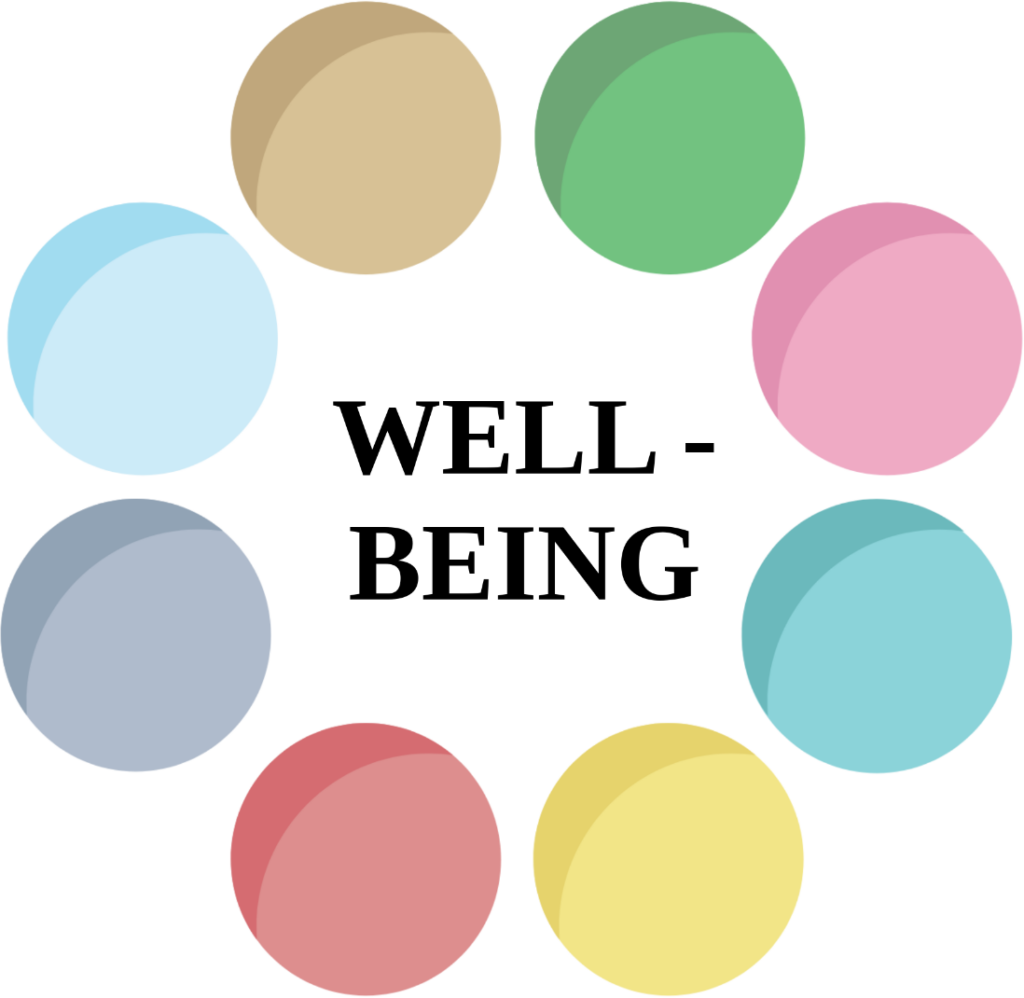
Draw a circle divided into 8 equal sections (like a pie chart). Label each section with one dimension of well-being. Mark your score on each spoke and connect the points to see the shape of your current well-being profile (analogous to RIASEC visualisation). Or use this kind of diagram with colour-coded circles representing different areas of well-being.
Contact person :
Katarína Štukovská, katarina.stukovska(at)gmail.com